
Giant Lance


There was no such thing as sunshine on an October morning in the Central Highlands of Vietnam, but at least it wasn’t raining. In fact, the perpetual layer of gray cloud had risen high enough to show the dark green ridges to the north of Firebase Valley Forge rolling off into North Vietnam, a scant three kilometers away. Corporal Johnny Bates sat in a hole hacked out of the red mud of the hilltop where the 5th Marine Regiment had decided to place Valley Forge, his eyes on the edge of the dark jungle that began fifty meters away, just beyond the concertina wire, and thought about home.
In seventeen days, a helicopter would carry him back to Da Nang, and then an airliner would fly him home to the World. His wife Sheila was waiting for him in San Diego with their two‑year‑old son Tommy. Another three months in the Corps and he was out, free at last to move back home to Killeen, Texas, and pick up his life where he had left off in 1965. He wondered where he would find work. He wondered if Tommy would remember him. He wondered how the World had changed since he went away.
The ear‑shattering bang of four 105mm howitzers firing simultaneously broke his train of thought: Charlie Battery at the top of the hill, sending Harassment & Interdiction fire into the spiderweb of trails that the North Vietnamese Army maintained down in the valleys, part of the Ho Chi Minh Trail that fed the war in South Vietnam. As the ringing faded from his ears, a low rumbling from the northeast replaced it. The rumble grew in intensity, and he scanned the sky for aircraft, expecting to see a formation of fighters on the way to some Marine unit in trouble.
“Hey, Johnny! Look at that!” Beal, a rifleman three holes down, was pointing at the horizon, where the dark silhouette of a plane stood out against the gray sky. Rather than the familiar speeding triangle shape of a Skyhawk or Phantom, it was an enormous cigar of a plane, with long, straight wings sweeping back from the nose.
“Jesus Christ, Beal, that’s a B‑52!” Bates called back. The huge Stratofortresses that flew Arclight strikes were usually too high to be seen or heard, their presence marked only by the distant thunder of bombs, but this one was below the cloud cover, no more than a few thousand feet overhead.
“Shit, he’s in trouble! Look at that engine!” yelled Albertson, the squad’s machine gunner. He was standing up in his hole, shading his eyes with one hand.
He was right. One of the bomber’s engines trailed a dark streamer of smoke.
“Must’ve gotten hit over Hanoi or something. Now the poor bastard’s trying to limp back to Thailand,” Bates opined.
The stricken bomber was passing almost directly overhead, just a few kilometers to the north. The Marines on the hilltop were craning their necks to watch it when the sharp‑eyed Beal gave a wordless shout of alarm and pointed again, this time due north. A yellow spark of flame was streaking across the sky toward the huge plane, a trail of white smoke leading back to a point deep inside North Vietnam. The B‑52’s pilot must have seen it, for the plane lurched and banked right; but the missile curved relentlessly toward it, and three seconds later detonated with a soundless flash just behind the right wing root.
A collective chorus of gasps, groans, and curses rose from the men on the hilltop. All along the perimeter, they were out of their holes, watching in horror as the B‑52 died. In a second, the huge plane had turned to flying wreckage, falling with all the randomness of an autumn leaf. The wing was completely detached, as was the tail section, when the boom of the exploding missile finally reached them. The roar of the engines changed to a protesting scream and a crackle of secondary explosions. Trailing black smoke, the remnants of the bomber tumbled to earth, momentum still carrying it westward toward Laos. Bates covered his mouth as it vanished behind a dark green ridgeline. A tiny mushroom cloud rose, followed some seconds later by a distant crash.
“Look, look! Somebody got out!” Albertson pointed at a spot midway along the B‑52’s path to the ground. A tiny human silhouette hung from a dark green parachute, swaying back and forth and falling fast. Bates stared for a moment like the rest, but then fumbled in the pocket of his green utility shirt and came out with a compass, then held it to his eye. The aviator’s parachute was descending very close, only one ridgeline north of the firebase, and he shot an azimuth as it disappeared on the far side. Leaving his squad still staring at the spectacle, he climbed out of his hole and ran up the hill toward the company command post, awkward on the slippery red mud.
Captain Hart, the company commander, had stuck his head out of the poncho‑and‑sandbag bunker that made the CP in time to catch the last few seconds of the bomber’s descent. Bates jogged up to him and pointed to the north.
“One of those flyboys got out, Captain! He went down just on the other side of that next ridgeline north of us! Peters better get on the radio and get a bird up there to pull him out before the gooks find him!” Hart nodded and ducked back inside, and Bates followed him into the dim interior.
“Peters, get regiment on the radio and let me talk to them.” The radioman nodded, put aside his magazine, and held the handset to his ear.
“Bearing is 334 from our spot on the perimeter, sir. That’s the last place I saw his chute,” Bates added.
Peters spoke into the radio. “Palehorse, this is Rockhound, how copy, over.” He paused, listening, then tried again twice more. He frowned, fiddled with the knobs on the PRC‑25, tried again, and shook his head. “Nothing but static, Captain. Let me try the battalion freq.”
Lieutenant Weller, Bates’s platoon commander, ducked inside the CP. “The men are saying they saw—” Hart cut him off with a wave of his hand. “We know. We’re trying to get a rescue bird right now.”
Peters hung up the radio handset and made a helpless, open‑handed gesture. “Sorry, boss. I can’t raise anybody. I tried every freq, and all I get is static.”
“Well, Goddamn. Check your antenna, Peters.”
“It’s been like this all morning, Captain. Charlie Battery’s radioman can’t reach anybody either. Sometimes it’s like this in these mountains.” He shrugged and picked up his magazine again.
Hart left the CP, with Bates and Weller following. Outside, most of the men were still watching the column of smoke rising from the distant crash site. He stared at it for a moment, then shook his head.
“Poor bastards.”
Bates spoke up. “So that’s it? We’re just leavin’ that flyboy out there with half the damn NVA?”
Hart shrugged. “What the hell do you want me to do, Johnny? We’ll keep trying to raise Palehorse and get him a chopper, but there’s nothing we can do for him other than that.”
“We can go over there and get him is what we can do, Captain. He’s just on the far side of that next ridge. A klick or two at most. Let’s take the platoon over there and grab him real quick!” His last sentence was addressed to Weller.
Hart shook his head. “Hell no. First platoon’s already out on that op down in the valley. I’m not pulling another platoon off the perimeter. We’re spread thin already. If the gooks hit us while you’re running around looking for that flyer, they’ll roll right over us.”
“You can’t just leave that man out there!” Bates was nearly shouting.
“It sucks, but there it is, Johnny. He knew the risks when he signed up, same as the rest of us.”
Bates took a step closer to Hart, his voice low and intense. “That flyboy just happens to fall out of the sky right next to the only American unit for twenty klicks in any direction, and you don’t see no purpose in that, Captain? God put him there, and us here, so we can go save him. We got to go and do this.” He turned and spoke to Weller again. “Please, LT. Just let me take my squad over there. Give me a radio and another gun team, and I’ll run over there and snatch him up before the gooks know what’s going on.”
Weller looked at Hart, who rolled his eyes and shrugged.
“Fine, Bates, go ahead. I’ll have first and second squads cover your piece of the perimeter. But have your asses back here by dark. Go look, but if you can’t find him in a couple hours, he’s on his own.”
Bates nodded gratefully and ran back down the hill, already shouting to his squad.
“Saddle up, boys! Don’t bring nothin’ but water, ammo, and frags! We’re goin’ over there and get that flyboy!”
As he reached the line of holes, his men merely watched him. No one moved. At last, Beal licked his lips and spoke.
“Hell no, Corporal. I’ve got three weeks left. No way am I risking my ass for some Air Force son of a bitch. You go get killed if you want to, but you can leave me out of it.”
Bates glared down at him. “He’s all by himself out there, Beal. We don’t find him, he ain’t got a snowball’s chance in Hell.”
“Why us? They got helicopters for that.”
“Not today they don’t. Radio ain’t workin’, can’t get no birds up here, so it’s up to us to go get him.”
Beal glanced at the other men of the squad for support. “Man, it’s crawling with gooks up there to the north of us.”
“Captain’s givin’ us another M‑60, and we’ll have a radio so the cannon cockers and the mortar squad can support us. Besides, we’ll be gone before the gooks know we’re there.” Weller chose that moment to come squelching through the mud, trailed by Roberts, his usual radioman, and Harrell, the machine gunner from second squad. Beal glanced at them, but his face was set.
Bates glared at him. “Goddamn, Beal. In the next day or two Palehorse Six will fly over in a helicopter and decide we need to go over there for some damfool reason that only he understands. He’ll tell us to, and we’ll do it, and maybe lose some guys while we’re at it, and we won’t ever know why. At least this time, we got a good reason. There’s a man over there that just fell out of the sky, scared and alone and praying to God to get him out of this. And here we are, right where we can help him. So cowboy up and let’s go. I’ll walk point. This might be the only useful thing any of us do in this Goddamn country.”
Albertson put a hand on Beal’s shoulder. “He’s right, Darrell. Come on, brother. Don’t leave us hanging.”
Beal glared up at him, lips working. He took a deep breath and snatched his rifle from the edge of his fighting hole.
“Fine, Goddammit. But if I get hit out there, it’s your ass, Bates.”
That did it. The squad began preparing to move, jogging off to fill canteens, draping ammunition bandoliers and belts of machine‑gun ammo around their shoulders, and seeing to their weapons. Weller handed Bates a map.
“I told mortars and Charlie Battery to be ready to support you. Their radio can hear the squad radio, but it’s real staticky. Be sure and call in DTs along the way.”
Bates grinned at him. “I know, boss. This ain’t my first rodeo.”
Five minutes later, the squad walked through a break in the wire and entered the jungle. The gloom closed over them, and each man scanned his sector, peering into the undergrowth for enemies. Bates walked point, with Private Chaplin five yards behind to keep an eye on the compass heading. Gambling that the NVA would not be lurking this close to the firebase, he set a rapid pace. Half an hour brought them to the bottom of the draw that separated Valley Forge from the ridge where they had seen the parachute descend. Bates let them rest and drink from their canteens while he called in a defensive target reference to the artillery, and then walked back down the line, touching each man on the shoulder as he passed. At the rear, Beal glared up at him without speaking. Bates returned his look, shrugged, and walked back to the front. They began to climb the hill.
The steep grade and the sticky mud slowed them considerably, and the fear of enemy contact slowed them even more. Bates picked his way through the jungle, each footfall carefully considered, senses alert, his rifle on full automatic. Every few yards he glanced back at Chaplin to be sure of his direction. Two men further back, Albertson and Brewer, the first machine‑gun team, followed, ready to bring their M‑60’s firepower into play if they met the NVA.
The vegetation began to thin out as they neared the top of the ridge an hour later. Bates took a knee, and motioned Roberts forward to call in another DT. He peered back through the trees, trying to catch a glimpse of Valley Forge, but saw only the hostile green jungle. Chaplin touched his arm, and pointed downslope. The column of Marines moved across the ridgetop and began to descend the far side.
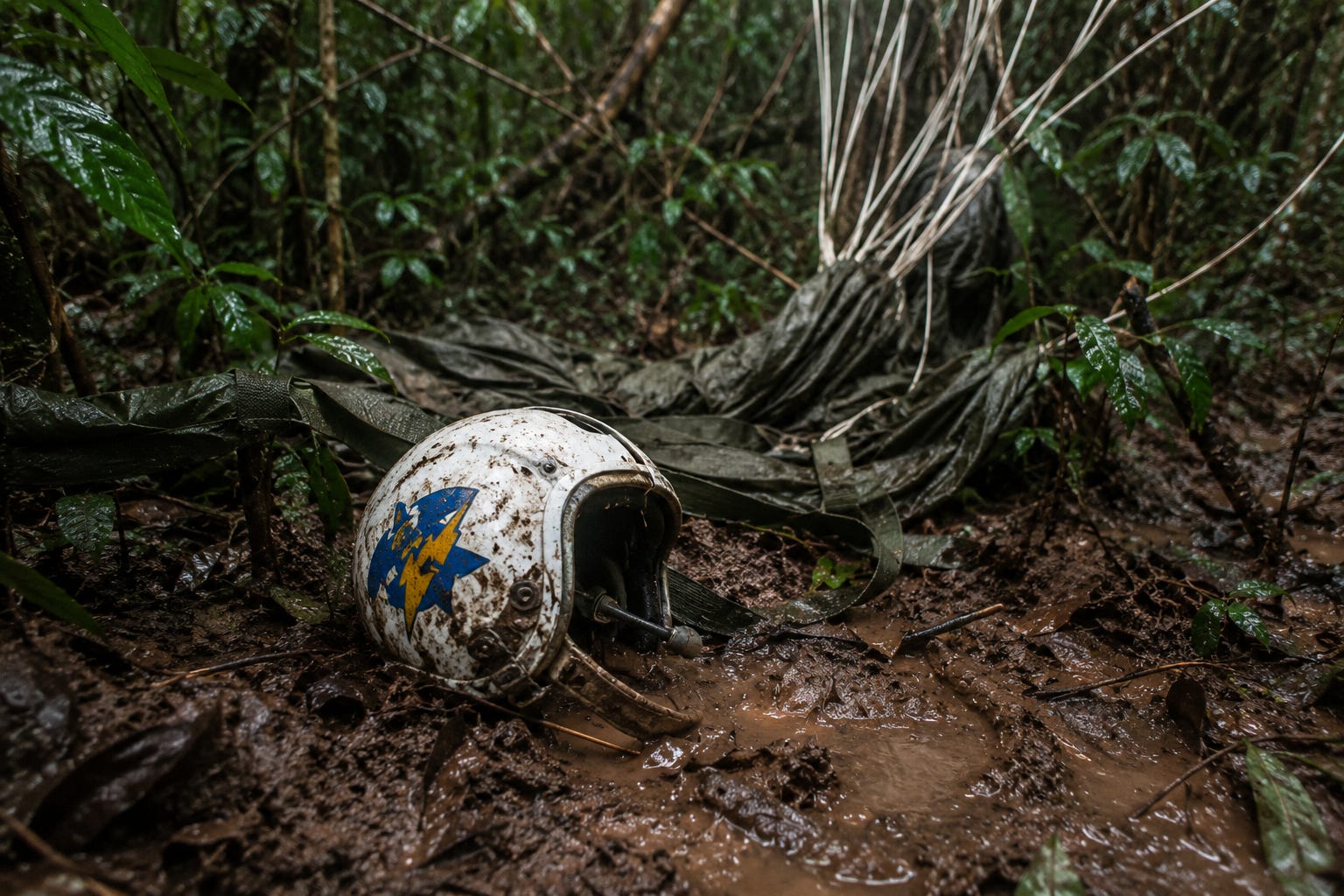
This side of the ridge belonged indisputably to the NVA, and Bates’s stomach tightened as he watched the dripping green jungle for any telltale shape or flicker of movement. A hundred meters downslope, his eyes passed across a tangle of vines hanging from a tall tree, and then snagged. The vines did not match the context of the jungle somehow, and after a moment he knew them as the work of human hands: parachute lines hanging arrow‑straight to the complex web of straps and buckles that formed the harness, which dangled about eight feet above the ground. High overhead, the silk canopy of the parachute was barely visible, cutting a circle from the gray sky above the trees. Bates beckoned Chaplin forward to cover him while he moved in for a look. Deep boot prints stamped the earth just below the harness, and in front of them, the impressions of knees and hands where the flyer had fallen. He took a sharp breath in. A few feet away lay a white flight helmet with a garish squadron emblem painted on it in blue and gold.
Bates scanned the ground, and the soft, damp earth rewarded him with another boot print, and then another. A clear trail led downhill. He shook his head and whispered to Chaplin.
“Goddamn lazy bastard, taking the easy way downhill. If he’d gone to the high ground, he might’ve seen Valley Forge through the trees and saved us the walk.”
Chaplin shrugged. “Cut the guy some slack, Johnny. The gooks just blew him out of the sky. He’s probably a little bit rattled.”
“Point.” Bates rose and moved downslope, his eyes watching the ground for tracks while Chaplin covered him from close behind.
Judging by the contour lines on the map, the draw into which they were descending was only about half the depth of the valley that separated the ridgeline they had just crossed from the firebase. Within half an hour, Bates could hear the tinkle of water running over rocks at the bottom. The tracks led straight toward it. He emerged from the thick cover onto the margin of the rocky streambed and sank to a knee, just inside the last fringe of vegetation, watching and listening, fearful of crossing an open area. The tracks disappeared on the rocks, and he wondered whether he would be able to find the airman’s trail again. He turned once more to look back for his squad. They were still there. Tired eyes in sweat-shiny faces met his. He ignored their wordless plea and looked back toward the stream.
Upstream to his right, Bates heard the rattle of rocks disturbed by a footfall. A bend in the stream hid its path, but he aimed his M‑16 toward the noise. A voice shouted something in lilting Vietnamese. Three quick shots banged out, someone screamed in pain, and the steady chug of an AK‑47 on full automatic answered with a short burst. The rocks rattled again with running footsteps.
Bates hit the ground and waved the squad forward into line on either side of him. Albertson and his assistant gunner crawled up on his right, and the black solidity of the M‑60 and its belt of brass cartridges reassured him. Upstream, there were more shouts in Vietnamese, and more bursts of rifle fire. The running footsteps came closer.
First a blur of motion, and then a man emerged from around the bend. Bates tracked him for a moment, his finger tightening on the M‑16’s trigger, but then dropped the muzzle, for the running man was a middle‑aged white man in an olive drab flight coverall, with a pistol clutched in one hand. They had found their flyer.
“Hold your fire! Hold your fire!” Bates called to the squad, his voice urgent. The aviator continued to run downstream, splashing heedlessly through the shallow water. He stopped, fired the pistol back upstream, then ran on.
“Over here! Americans, Americans! Over here, dammit!” Bates shouted to him. The man stopped and looked toward him, face red with heat and exertion, eyes wild with fear, and aimed the pistol at him. Bates cringed and tried to sink into the ground, but continued to shout. “Don’t shoot, Goddammit! We’re on your side! Come here!” The man understood and scrambled toward them, covering the distance in a few seconds and leaping into the jungle. He dropped to the ground just behind the line of Marines, gasping for air.
In the streambed below, a North Vietnamese soldier came around the bend in a green uniform and pith helmet, rifle ready and eyes searching for his quarry. He ran, following the watercourse downstream, trailed by four more comrades. Bates took aim at the man, waiting for more enemies to enter the kill zone of the Marines’ hasty ambush, but one of the men to his right lost his cool and fired a long burst on full automatic. The whole squad opened up, and the storm of bullets from ten rifles and two machine guns cut the running NVA down.
There were still enemies upstream, for more AKs returned fire, and bullets began to rip through the leaves above the Marine squad. Bates looked to his left, seeing a fire team leader named Upton next to him. The flyer was just behind, pressing himself to the earth.
“Upton!” Bates called. “You and your team take this flyboy and pull back twenty‑five meters and cover us! We’ll be along shortly!” Upton nodded, and the four men rose and crashed off into the bush, taking the airman with them. The remaining men kept firing at the unseen enemy upstream until Bates heard Upton’s faint voice calling from uphill. “Come on boys, we’re buggin’ out!” he shouted to the squad, and together they rose and ran. Bushes and vines clutching at them, they lumbered through the green jungle, pursued by bullets, until they passed through Upton’s team. Bates grabbed the flyer by the sleeve as he passed, and continued uphill another twenty‑five meters, then dropped to one knee and aimed downhill. Below them, Upton’s team opened fire, a brief blast of bullets driving their pursuers down, and then withdrew, emerging from the greenery a few moments later and passing through Bates’s line of men. The aviator had figured out the rules and rose to run with them as they continued back toward the crest of the ridge.
Down below, Bates heard shouts and the shrill scream of a whistle. Rustling in the bushes to his right and left told him the NVA were spreading out in a line to sweep uphill, flanking the fleeing Marines. He called out to his squad, “Give ‘em one mag, then throw a frag and bug out!”
They did not have long to wait. A disturbance in the brush ahead resolved into a soldier in green, AK held out in front of him. Bates let the front sight settle on the man’s chest and pressed the trigger, and the man went down. All along the line, men were firing. Bates fumbled a grenade from a pouch, pulled the pin, lobbed it downhill, and ran. A short distance later, they passed below the parachute in the tree, and caught up with the other team at the top of the ridge.
Gasping for breath, Bates snatched the radio handset from Roberts. “Hammerhead, this is Rockhound Three One actual, fire on defensive target three!” After a long pause, the radio crackled back, “Roger, Three One. Shot out.” Distant through the jungle, the 105s back at Valley Forge banged, and the mortars fired with lighter thumps. Time slowed as he waited, and then the rounds were impacting fifty meters downslope, sending shrapnel, dirt, and shredded vegetation ripping through the leaves.
“That gives us some breathing room! Let’s go!” Bates shouted, and the squad continued their flight downhill, into the last valley before the relative safety of the firebase. The route that had taken them an hour to traverse on the way, uphill and moving with caution, now took them ten minutes.
Halfway to the bottom, progress slowed, and Bates ran forward to find the airman down on hands and knees, vomiting into the red mud at the base of a tree, eyes blank and face scarlet with exertion. He looked at the men around him and stammered an apology between heaves.
“We ain’t got time for this! Pick him up and keep movin’, dammit!” Bates barked. A couple of Marines slung their rifles across their backs and dragged the man to his feet, and he stumbled on downhill, his arms wrapped around their necks. Back uphill at the rear of the column, an M‑60 hammered out a long burst, followed by the faster rip of M‑16s and the deep rattle of AKs. Bates cursed and yelled for the radio, then pulled out his map. “Hammerhead, hit defensive target two, they’re pushin’ us hard!”
“Roger, Three One, standby.” The radio went quiet, while above them the firing reached a crescendo. “Rockhound Three One, shot out.” An enormous crack passed overhead like invisible lightning, and rounds detonated uphill. A minute later, the rearguard emerged from the jungle. McCool, the assistant gunner, had blood soaking into the right side of his utility shirt and walked supported by a rifleman, his face tight with pain. Bates counted his men through as they passed. Albertson brought up the rear, stopping every few yards to fire short bursts back uphill.
“On my last belt, Johnny!” he gasped as he ran past. Muted by distance and the thick jungle, short whistle blasts and singsong Vietnamese reached them from above. Once again, Bates spoke into the radio. “Hammerhead, drop fifty and repeat. Break. Rockhound Six, we got two wounded and they’re right on our asses, can you send a squad out to bring us in?”
The radio crackled, and he recognized Hart’s voice. “Roger, Three One. Rockhound Three Actual headed out with a squad ten minutes ago. He should be almost to you.”
“God bless you, Six. They must want this flyboy real bad.” Bates hung up the handset and used his last bit of strength to run back up the column, passing his exhausted men until he reached Upton’s team at the front, still carrying the flyer. They had passed the valley bottom and were partway up the last slope to the firebase.
“The LT’s bringing a squad down to pull us out, Jack. Make sure you don’t shoot at them!” He shouted the platoon recognition signal up the slope. “Batman, Batman!” Relief flooded through him as a faint voice replied, “Robin!”
Ten minutes later, the two squads jogged through the gap in the wire onto the firebase. McCool was being carried by two other Marines, but the flyer had recovered enough to walk on his own. Mortar rounds still banged in the jungle behind them, discouraging the North Vietnamese from further pursuit. Bates was the last man in the column, and as he approached the line of fighting holes, he saw that Hart had come out to meet them.
“Nice work, Johnny. I never thought you’d find him.” Hart leaned in close. “I’m putting you in for a Silver Star. And as soon as the radio starts working again, I’ll talk to Sergeant Major Neill at battalion and get you a nice safe housecat job back in Da Nang until your time is up.”
A huge smile split Bates’s muddy face. “Thank you, Captain. Can you get these boys moved up the list for R&R, too? They done all the hard work.”
Hart slapped him on the shoulder. “I’ll see what I can do.” He turned to the airman, who was drinking long gulps from a canteen someone had handed him.
“Well, Air Force, welcome to the real war.”
The man swallowed, and lowered the canteen. He was average height, with close‑set eyes and light brown hair shot through with gray, perhaps thirty‑five or forty. His face and body had the fullness of a man who ate regular meals, a marked contrast to the bush‑skinny Marines around him. He looked at Hart, and then at the faces of the men who stood around him.
“Thank you for pulling me out of there. I thought they had me.” His voice broke, and his face crumpled as tears ran down his cheeks. “Thank you all so much.” He looked over at McCool, who lay on the ground with the corpsman working on him. “Oh Jesus Lord. Is he going to be OK? I’m so sorry he got hurt. Thank you all. Thank you.” He looked back at Hart. “Did…did anyone else make it out of the plane when we got hit?”
Bates shook his head. “I’m sorry, Air Force. Yours was the only chute we saw.”
The airman sobbed and fell to his knees, with his face in his hands. Embarrassed, the Marines around him turned away and drifted back to their positions on the perimeter.
Hart let the man weep for a few minutes, and then squatted down and patted him on the back. “I’m sorry about your crew.” He and Bates helped him to his feet. “Come on over to the command post. You look like you need some rest.” Together, the three of them walked uphill and ducked into the dimness of the CP, where Peters still sat with the radio. Inside, they sat on the stumps that served as chairs. The airman’s sobbing had subsided, and he was breathing normally again.
“I’m Larry Hart, and the man who brought you in is Corporal Johnny Bates. This is Private Peters.” He extended a hand, and the airman shook it.
“Staff Sergeant Bob Turner, 92nd Bomb Group.”
“Welcome to Firebase Valley Forge. Bravo Company, 1st Battalion, 5th Marines. I guess you boys were flying out of Guam?”
Turner shook his head. “Fairchild Air Force Base, outside of Spokane.”
Hart whistled. “Jesus Christ, you flew from Washington State to bomb Hanoi?”
The airman shook his head again, and rubbed at his chin. “Not Hanoi. Our target was Drovyanaya.”
Hart frowned. “Where the hell is that? Doesn’t sound Vietnamese to me.”
Turner made eye contact for a split second and then looked away.
“Siberia. The 4th Rocket Division.”
Bates broke in, his eyes wide. “Siberia? You mean, inside Russia?” Turner met his gaze and nodded. “You bombed the Russians? With…with an H‑bomb?” Another nod.
The three Marines sat in shocked silence. Outside, a single howitzer fired with a shattering bang, a reminder that the war went on. When Bates spoke again, his voice shook.
“So we’re in a war with the Russians.”
Turner licked his lips. “I guess so. We never got any orders. We were just flying toward our fail‑deadly point like we always did, waiting for the recall code to come in.” He paused and looked outside. The clouds had dropped down on them again, and it had begun to rain; the fat drops were loud against the poncho roof, and on the mud that surrounded them.
“But it didn’t come. So we kept going toward our primary target. The missile field at Drovyanaya.” His eyes were far away. “They were launching as we came in for our bomb run. But we must have gotten at least some of them.”
Bates found he was staring down at his trembling hands. Sheila and Tommy, in their little apartment two miles from the Navy base at Coronado. He faded back into awareness. Turner was still talking.
“We were supposed to land at Kunsan, in Korea, but we got close and they’d already hit it. The same thing at Kadena in Okinawa, when we tried there. It was just gone. Nothing but fire, and smoke as high as you could see. So we tried to make Clark Field in the Philippines. We were a hundred miles out when we saw a flash and a mushroom cloud. Lieutenant Ritter said we had enough fuel to make Nakhon Phanom in Thailand, so that’s where we headed when that SAM got us. I don’t know if it’s still there.”
Captain Hart spoke for the first time. “Peters, how long has the radio been on the fritz?”
“Five or six hours, sir.”
The airman nodded. “We never could raise anybody at SAC on the radio, or anybody else. They always told us if enough bombs went off, it would play hell with radio reception for a while.”
Bates realized his cheeks were wet with tears. “Seventeen days. I’m going back to the World in seventeen days.” He stared at the airman with a prayer in his eyes. Turner met his gaze, and shook his head.
“I don’t think the world’s there any more.”
 | A guest post by
|